



Alienation or Collaboration? Mentors, knowledge, and corporations in the age of AI
Index
Am I walking straight into the oven like a total fool?
This is the question that kept me nagging while I was training an AI agent. Its purpose? To coach workshop participants on how to give feedback to their colleagues — a cornerstone of knowledge sharing that we had just explored together in person the day before.
At times, the experience felt profoundly alienated. In just 4 to 6 hours of work, I condensed twenty years of expertise, built through decades of field experience, courses, mentoring, and endless reading, into a single, massive prompt and handed it over to the machine.
And yet, I told myself I was building a tool that transcends the limits of my own time and energy. To bring those students to full “fluency” would have required hundreds of hours of my personal time and thousands of euros in investment from them. On the other hand, I still retain the ability to deliver content in a compelling way in the classroom, something no one can take away from me, at least for now. Assuming I ever had it! 😄 Who knows for how much longer, though.
This reflection triggered a reminiscence of 19th-century philosophy and 20th-century politics: the Marxian extraction of value from labor to capital. In Marx’s language, “extraction” meant exploitation.
In today’s Italian context — still shaped by ideologically charged industrial relations — I am trying instead to envision an evolution in the relationship between capital and labor. One is based on collaboration, where knowledge is not alienated but becomes an object of mutual investment. The difference lies in the pact through which we capitalize on knowledge, even if it never appears on a formal balance sheet.
The knowledge monopoly in business: from the Egyptian scribe to the present day
Power linked to “esoteric” knowledge — meaning knowledge reserved for a few — is a constant throughout history. The scribes of ancient Egypt held a monopoly on writing and, consequently, on administrative power. Today, their heirs sit in certain offices or production departments where the phrase “Only he knows how it works” can still be heard.
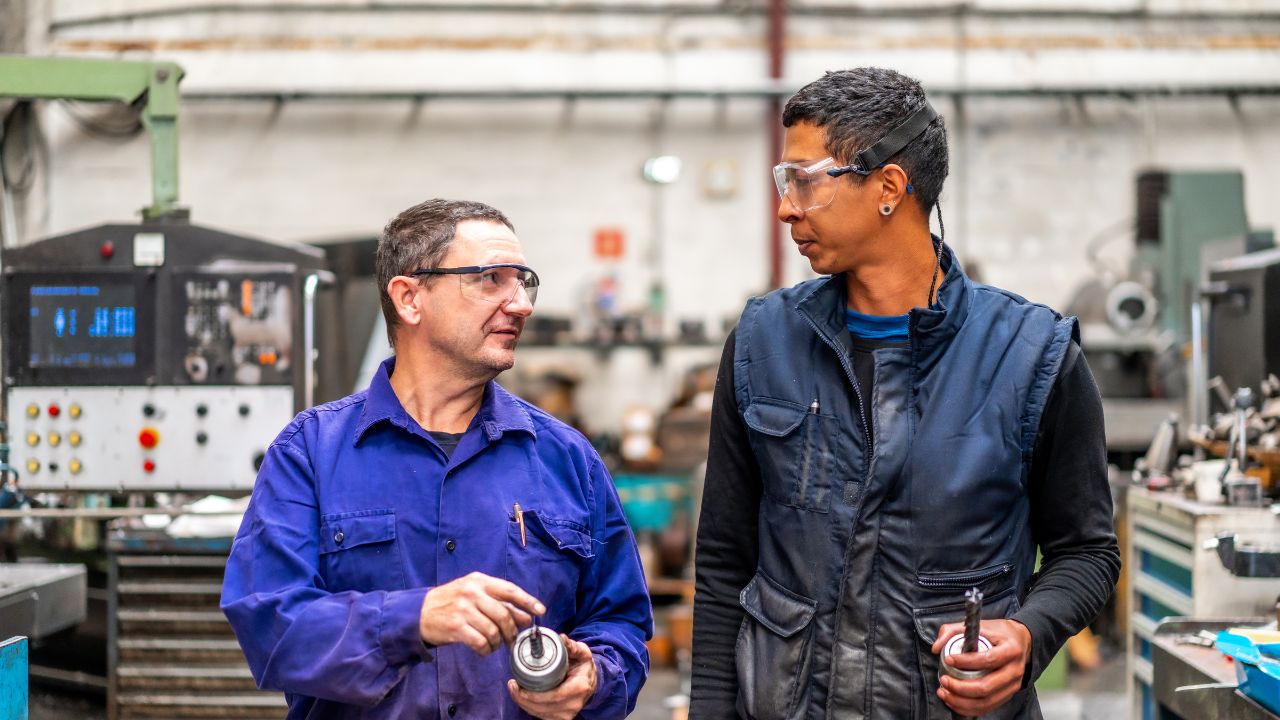
One of the moments when I gain the most consensus in a company, during development programs for operator and technician multi-skilling, is when I ask the working group this question:
“In your professional history, have you ever encountered that mega-expert who kept all his knowledge to himself, someone who even hid while performing certain tasks to prevent others from learning by watching him?”.
And everyone nods and laughs.
“That’s the trade sinking in”, a glassworks shift leader told me 20 years ago (with a certain self-satisfaction) while we were analyzing an injury to a younger colleague who had cut his arm.
This type of power speaks of a world made of class struggles, and struggles within the working class itself, born of a bygone — Fordist — era, where those at the top decided what should be done and those at the bottom executed it. And when those at the bottom discovered a trick, they kept it to themselves so those at the top wouldn’t use it against them to increase productivity targets.
There have been cultural revolutions — including the advent of Lean — that have transformed this way of understanding organization. Where old dynamics persist today, it means the company leadership has not yet taken on the task of structurally valuing knowledge sharing.
If these processes are spontaneous or non-existent, they make the company dependent on a few “chosen ones of knowledge”; if they are present and structured, they free the company from a state of further vulnerability in these already unpredictable times.
To be clear, I am not blaming those old masters who kept their trade to themselves: it was an effective survival strategy during decades of staff cuts in corporate cultures that lacked the pact I mentioned before.
Modern-day mining: the invisible miners of AI
If the scribes guarded knowledge by being careful not to disclose it so as not to lose their relative privileges, today Big Tech has been able to extract it even exponentially. The major artificial intelligence groups have built their models thanks to millions of hours of underpaid human labor or through the abuse of copyright. An investigation by the Financial Times (2024) revealed how tens of thousands of data labelers in Kenya, Uganda, and the Philippines worked for less than 2 dollars an hour to label text and images, correct responses, and filter violent content (God only knows what they had to see: worse than A Clockwork Orange!).
This work was necessary to “train” the models that are now worth billions (at least according to stock market capitalization).
Once the training was completed, many of those workers were laid off. We are thus witnessing an episode of knowledge capitalism without a pact of reciprocity between employer and worker.
It is an example of modern Fordism in its earliest form—that is, before Ford decided to increase wages from 3 to 5 dollars (while simultaneously introducing a system to control private behavior so that workers wouldn’t squander that money on alcohol… but more likely on cars. But that is another story).
The Toyota model: knowledge sharing as a competitive advantage
At the opposite extreme lies the Toyota model. In 2008-2009, the company went through the worst crisis in its history, with a drop in orders of more than 20%, yet it did not lay off anyone. Granted, it did not renew some of the contracts for temporary workers, but it did not let go of any of its permanent employees. It kept jobs intact, even at the cost of halting production, and invested those weeks in internal training, maintenance, continuous improvement, and multi-skilling development. The pact between the company and the individual was: “You share everything you have learned to the fullest, and I will provide you with security and trust, and invest in your training.” It is from this alliance that authentic kaizen is born: the kind that transforms problems into opportunities for collective learning.
How to choose the right business mentor
When it comes time to decide who should mentor talent, the most frequent mistake is choosing the “technically best” person, as they often do not correspond to the one with the greatest desire or ability to share knowledge. Sometimes, when we must make this choice in a company, I offer the working group members a visual that “plots” candidates on two axes: on the x-axis, how much they know, and on the y-axis, how good they are at teaching. Then, when we are torn between 2-3 people, I ask the fateful question regarding the set of reinforcers, commonly called the “set of rewards”: “How much joy do they get from seeing others learn?” versus “How much joy do they get from demonstrating their superiority?”. I look for a pragmatic effect because – in a clinical setting – it takes much more effort to change the “reinforcer” than to change the behavior associated with it. If our expert finds pleasure in seeing their colleagues grow, I, as a manager, will not have to invest much of my time monitoring the mentoring activity, because it already has its own “built-in” gratification.
You can well understand that in our “slightly” individualistic cultural model, the act of pulling others up risks bringing them to “your” level; therefore, in some companies, these mentors are hard to find, hidden among “jealous mushroom hunters” (those who know where to go but would point you toward a ditch rather than reveal their secret spot; those who, when you ask “how did it go?”, always reply “terrible, there’s nothing, just a few chanterelles at most”, while they’ve just tucked a bag full of porcini into their car!).
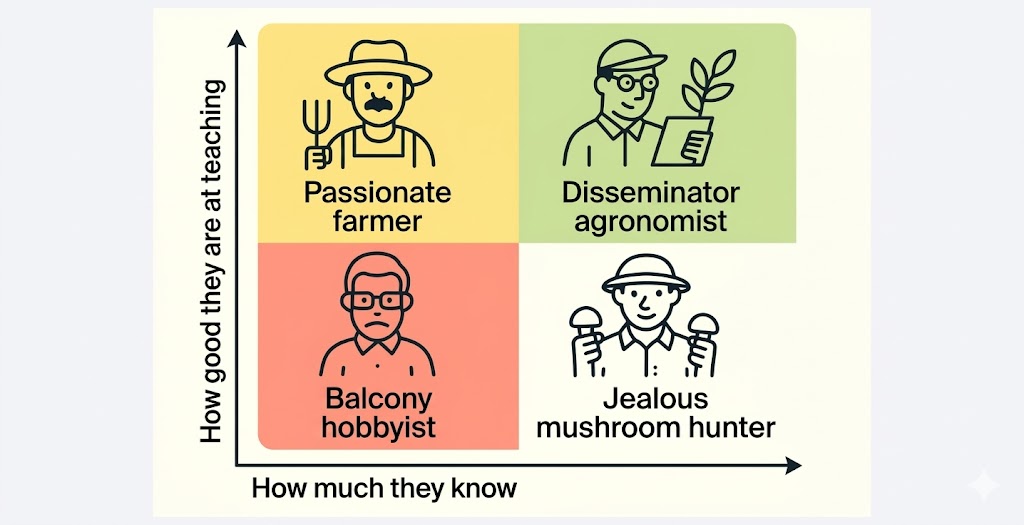
We go in search of “outreach agronomists,” the Rita Levi-Montalcinis who fall in love with the subject and manage to transmit it. And if we cannot find these masters, we prefer “passionate farmers” over jealous mushroom hunters, people who might not know all organic chemistry, but who love their work and make those who listen to them flourish.
And then there are the balcony hobbyists, who could talk for two hours at an aperitivo with conspiracy theories about agriculture, yet still can’t manage to make a pasta dish with their own homegrown tomatoes. You’re better off losing these people than finding them. Fortunately, they are quite recognizable and there’s no shortage of them here in Italy: we call them cialtroni.
Evidence-based practices for knowledge sharing and talent retention
1. Structured and bi-directional mentoring
A 2004 longitudinal study by Allen et al. (Journal of Applied Psychology) involving 1,100 employees in the banking and manufacturing sectors showed that those participating in structured mentoring programs have a 23% higher probability of staying with the company compared to colleagues without a mentor. The most interesting finding is that mentors, not just mentees, also increase their job satisfaction and sense of belonging. The experimental design included an initial measurement (T0) and a follow-up 18 months later (T1) to detect the actual turnover rate, controlling variables such as seniority and job level.
2. Job rotation and cross-training as retention tools
A quasi-experimental study conducted by Campion, Cheraskin & Stevens (1994, Academy of Management Journal) in an American multinational divided 24 similar departments into two groups: half introduced planned job rotation, while half maintained stable roles. After 12 months, the departments with controlled rotation recorded a 17% increase in retention and a higher perception of fairness in learning opportunities (measured via a 5-point Likert scale survey).
3. Psycological safety and dialogic feedback
In one of the most well-known research papers by Amy Edmondson, published in Administrative Science Quarterly in 1999, 51 clinical teams across 8 hospitals were observed in the field for 6 months. Teams with high levels of psychological safety (measured through interviews and Likert scale questionnaires) reported more errors – not because they committed more, but because they felt free to discuss them. The result was counter-intuitive: those groups improved their performance by 35% more in the following semester.
Does the pact already exist in your company — or is it still yet to be built?
These three insights show that it is not enough to say “share what you know”; you must create contexts where doing so doesn’t cost reputation and represents an advantage even for the person who is expected to share. When the pact between the company and its collaborators is strong, knowledge sharing is no longer an act of altruism, but one of mutual investment.
If you recognize some of the dynamics described here in your company – knowledge concentrated in a few, mentoring left to chance, turnover that drains expertise – discover how Lenovys supports organizations in building a structured system for knowledge transfer.
Article written by:

Alessandro Valdina
Principal
In his university studies there are Communication, Finance and Applied Behavior Analysis. Head of Lenovys' "People & Organization" area, as a management consultant helps organizations achieve safety, quality, production, service and sales goals through measurable improvement in individual and group behaviors. His areas of expertise cover Change Management, Strategy Deployment, Lean Office, Performance Management, Leadership Development and Training Technologies.
Read more