





Strategic PMO: aligning strategic execution with Business Evolution

Ninety percent of managers and executives admit that they have failed to successfully implement parts of their strategy, leading to a waste of resources, destroying corporate productivity, and risking a misalignment of people with strategic objectives.
The Economist Intelligence Unit, in collaboration with the Project Management Institute, highlights that every 20 seconds, one million dollars is wasted due to poor execution of corporate strategy. That amounts to two billion dollars every year – equivalent to the GDP of Brazil.
88% of surveyed managers stated that the success of their strategic initiatives will be “essential” or “very important” for their organizations’ competitiveness in the coming years. Around two-thirds report having difficulty implementing corporate strategy through daily actions, and more than half state that this weakness in executing their strategy puts the company at a competitive disadvantage.
Every day, every company faces new opportunities and challenges: without a clear and consistent game plan to prioritize what to work and invest on, time, energy, and money can be wasted.
This is why organizations invest time and resources into developing strategic plans. Strategy reflects an organization’s awareness of itself and its competitors, its markets, the political and regulatory environment, and, above all, its future goals. It integrates the vision of business leaders with the entire organization regarding the plans to make that vision a reality over time.
Strategic Program Management: the link between strategy and projects
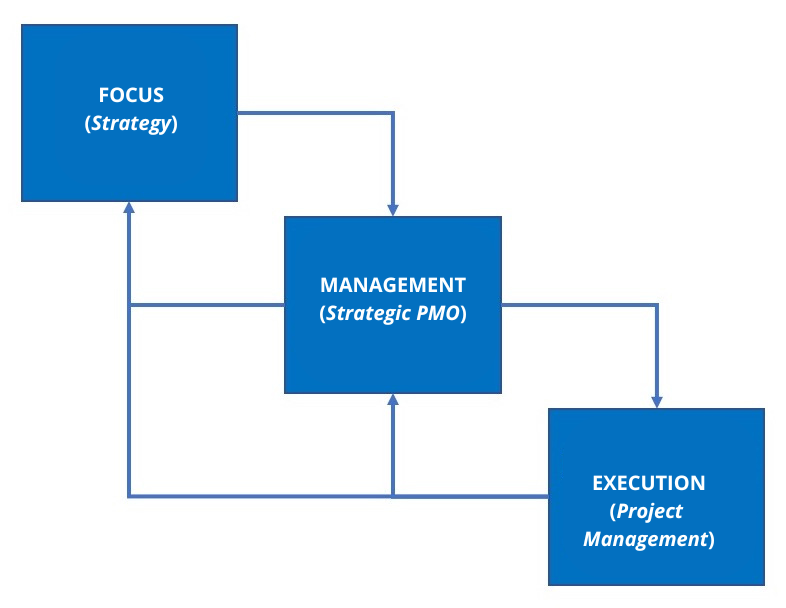
Despite the intent and the effort put into making strategy a reality, we witness daily a disconnection between the development of strategic plans and the day-to-day work that should make those plans a reality. This is why, now more than ever, it is of vital importance for companies to adopt a system that serves as the necessary bridge between the development of strategic plans and the execution of project plans: to remain relevant in their markets, organizations must simultaneously optimize both how they run the business and how they change the business.
Yet, as we know, the link between strategy and the projects designed to implement it has not always been obvious to corporate management, which tended to view project management as a tactical tool. All too often, projects are launched and executed with little to no connection to the corporate strategy formulated by top management.
One of the reasons is the lack of an organizational structure or entity with the clear responsibility of linking strategy to projects and monitoring those projects to ensure they remain aligned with corporate strategic priorities, in line with today’s changing conditions that require organizations to have considerable agility – both organizational and strategic.
In numerous projects, we have supported companies in setting up and running a structure with processes, tools, and habits that we call the Strategic Program Management Office (Strategic PMO).
The Strategic PMO, a key organizational element for successful strategy execution, does not necessarily have to be a department made up of numerous people. In fact, in small to medium-sized businesses, it can be represented by a single person who dedicates part of their time to implementing a proper strategy execution system.
Regardless of labels, by providing a standard organizational methodology for planning, executing, staffing, prioritizing, and learning from all the projects that comprise strategy execution, the PMO delivers the organizational and execution consistency required to fulfill a company’s strategic initiatives.
The purpose or mission of a Strategic PMO is achieved by:
- ensuring that the enterprise invests in the best set of projects and realizes the greatest possible benefits from these investments;
- providing an organizational focus on improving project management;
- optimizing the capacity and use of available resources;
- highlighting critical issues during the execution process to the company’s top management, to facilitate the development and implementation of appropriate countermeasures.
To achieve excellence in strategy execution, a series of essential conditions must be met when implementing a PMO:
- Bridge: the PMO must be the “home” of the strategic document produced by corporate leadership, converting it into projects that fulfill that strategy. By providing corporate leadership with an operational “pulse” through the definition of milestones and targets for strategic initiatives, it promotes clarity and alignment across the entire organization around key strategic goals;
- Management: from its strategic vantage point, the PMO selects projects, defines their priorities, and manages their dependencies by establishing standard processes and routines that track project milestones and objectives, communicate progress, and help identify critical issues early on;
- Center of Excellence: it fosters and develops the right technical, strategic, business management, and leadership capabilities within the organization, in line with the strategy;
- Habit Management: it encourages and implements a culture of change, actively building commitment and support across the entire organization for the execution of strategic initiatives, elevating change management into a truly competitive differentiator;
- Centralization: by taking on the processing and reporting of key performance data for both the company and individual strategic projects, it enables the organization to measure whether the chosen strategic directions are suited to the set goals, quickly highlighting any deviations from strategic targets;
- Integration: by integrating with other business functions, it becomes the company’s “nerve center” where the main initiatives and corporate functions can and must interface.
The glue between strategy and action
In today’s markets, characterized by persistent and complex change, organizations must effectively and efficiently govern strategy-driven actions to internalize—with the necessary agility—the strategic changes demanded by the ecosystems in which they operate. Having an organizational entity that governs business transformation and acts as the glue between the Business Evolution mapped out by strategy and the actions that will implement that evolution is an imperative that business leaders can no longer ignore.
The PMO ensures the right level of management engagement with operational levels by establishing meaningful milestones and objectives, along with smart, simple routines that track progress without adding new burdens to business processes, all while developing the right talent and supporting the organization in its evolution.
In this way, it builds a set of interconnected corporate capabilities and insights that reinforce one another, leading organizations to the successful implementation of their designed strategies.
Article written by:

Riccardo Siciliani
former Manager Lenovys
He is a Manager in the Delivery Unit Strategy & Innovation at Lenovys, and manages projects related to the definition and implementation of corporate strategies, the innovation systems and application of Lean Product and Process Development principles with clients operating in the manufacturing, food & beverage and financial services sectors.
Read more


Upcoming events